While Londoners basked in a heatwave during June and July, Dr Neville Butler travelled to cooler climes north of the border to meet Scotland’s health chiefs about including Scottish mothers and babies in the survey.
Dr Butler confirmed that Scotland’s department for health had “expressed willingness to cooperate” but would need to give help and advice on the “statistical aspects of the Scottish side of the survey”.
There had been no further news about Dr James Douglas’s proposed rival study of babies, and Dr Douglas would not be present at any of the steering committee meetings before the study was launched.
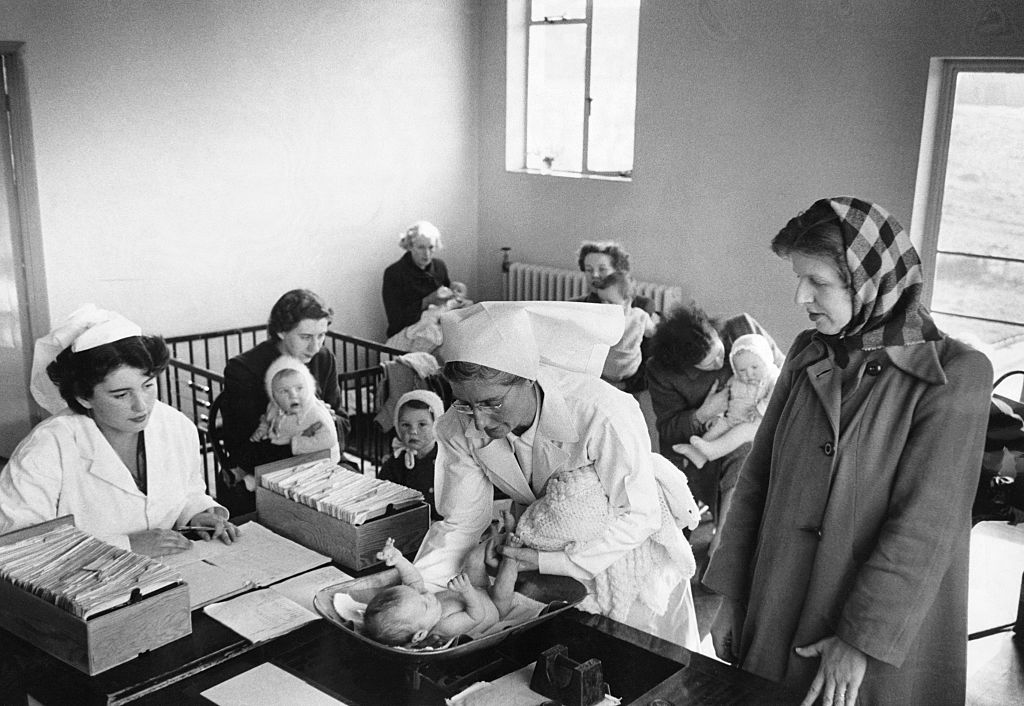
Nurse weighs baby in health centre. Bristol, UK, 1950. Midwives helped to gather vital information for the survey following birth. (Photo by © Hulton-Deutsch Collection/CORBIS/Corbis via Getty Images)
With three nations now in the survey it had increased from 15,000 babies to more than 17,000. As a result, Dr Butler said the survey would take place during the first week of March 1958, rather than November 1957 as originally planned.
Across Britain, increased production in major industries such as steel, coal and motor cars had led to a rise in wages, exports and investment.
The burgeoning shoots of the Britain’s cultural revolution were also becoming apparent. Two teenagers, John Lennon and Paul McCartney, would meet at a garden fête in Liverpool that summer, changing the course of popular music forever.
Britain’s scientists continued to unearth important discoveries that would help to improve the health of people across the UK and around the globe. A report by the Medical Research Council revealed the first evidence to support a link between tobacco smoking and lung cancer.
Dr Butler carried a similar sense of purpose as he prepared to meet with the 23-strong committee in Belgravia on that balmy summer evening.
After long days working in their respective hospitals, GP practices and offices, members of the committee may have hoped for a brief respite from the stifling weather in nearby Green Park before their evening meeting in Lower Belgrave Street.
As the committee cooled down, Dr Butler took centre stage to outline his mission statement for the survey: “the main objective of the survey is to attack, on a national basis, the urgent problem of reduction of perinatal deaths, at present numbering approximately 26,000 yearly.”
With midwives already recruited to administer the questionnaire to mothers, it had also been agreed that health visitors would gather important additional information about the health and feeding of the babies by the time they were eight weeks old.
Dr Butler said he had met with his scientific colleagues across the length and breadth of the nation and had received “the most encouraging promises of cooperation with the survey”. He had addressed meetings at the Royal College of Midwives and said that every help had been offered.
It was estimated that the total cost of the survey would be between £10,000-£20,000, which would equate to £200,000 – £400,000 in today’s money.
The study’s main sponsors, the National Birthday Trust Fund (NBTF) announced that they had secured £2,000 from the Joseph Rowntree Village Trust. The Ministry of Health then promised to provide its expertise and technology to conduct the coding, tabulating and statistical work for the survey.
While previous pilot surveys had mostly gone to plan, Dr Butler explained that a survey in Nottingham had shown that midwives had encountered problems completing the main questionnaire if there were complications with the birth. This had doubled the amount of time it took them to complete the survey. However, the planned additional health visitor questionnaires were completed at eight weeks with little difficulty.
At the turn of the year, Dr Butler met with the committee to give an update about the final preparations for the survey.
It was decided that the eight week follow-up survey would have to be abandoned “because of the immense amount of work required to visit the babies”. However, the main survey was back on track.
Dr Butler had embarked on a number of valuable visits to leading research groups, particularly the MRC Obstetric Medicine Research Unit at Aberdeen. They stressed the importance of obtaining detailed clinical information on pregnancies and labours resulting in stillbirths and neonatal deaths. Consequently, a set of narrative questions would be included where midwives could provide further details.
A study in the United States showed that babies whose mothers had smoked during pregnancy tended to weigh less at birth than babies whose mothers had not smoked. This led to Dr Butler and his team adding another question about mothers’ smoking habits, which would lead to some of the study’s most influential discoveries.
With these last minute additions to the questionnaire, the survey would be sent to the printers and be available for distribution by the end of the week beginning 21 January. During the following weeks before the survey started, Dr Butler would convene a number of briefing meetings around the country to confirm plans.
As the March birth week approached, efforts to publicise the survey intensified. Dr Butler reported that the British Medical Journal had agreed to publish details of the study two weeks before it began. Articles were planned for nursing journals, and a press conference was proposed to secure national publicity. Lady Rhys-Williams of the NBTF hoped the survey would also be featured on BBC radio and television ‘women’s programmes’.
It had been an unseasonably cold start to March with record lows of -22c in the Highlands and freezing temperatures in London.
While mothers braved the icy chill wrapped in their warmest coats and scarves, Britain’s midwives were ready to bring a special generation of babies into the world. During the week of 3-9th March they interviewed 98% of mothers, collecting information on 17,415 newborns.
Reporting on the success of the survey, Dr Butler noted that midwives across Britain had completed thousands of questionnaires, working voluntarily in their spare time to fill in the main survey questionnaire and clinical summaries for stillbirths and neonatal deaths.
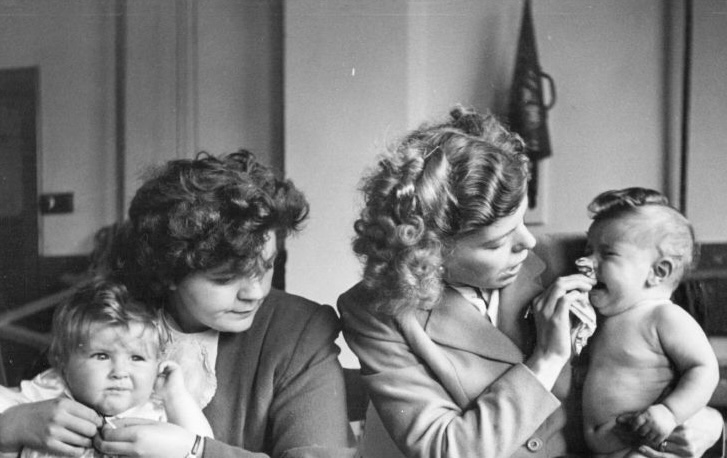
Pair of young mothers with their babies. 1952. Dr Neville Butler said the survey received a “magnificent response” with more than 90% of births recorded. (Photo by Haywood Magee/Picture Post/Hulton Archive/Getty Images)
Speaking with the British Medical Journal later in 1958, Dr Butler said “the return of completed questionnaires received by the survey up to 31 October had reached 95% of the 18,005 live births notified between March 3 and 9 and 91.3% of the 8,316 perinatal deaths in March, April and May”.
In an article in The Medical Officer, Dr Butler said that “it was agreed that these results indicated a magnificent response from all those who undertook to cooperate with the work of the survey, and the steering committee expressed great appreciation of the invaluable help given”.
Dr Butler explained to the Nursing Times that “the next stage is the coding and tabulating of information on the schedules which is being carried out by the Social Survey. The study of this large mass of material – probably unique in its scale – will take considerable time but it is hoped to publish some of the results by the end of 1959 or early in 1960”.
Reporting on the progress of the study, he told the British Medical Journal that “the return of completed questionnaires received by the survey up to October 31 had reached 95% of the 18,005 live births notified between March 3 and 9 and 91.3% of the 8,316 perinatal deaths in March, April and May”.
In an article in The Medical Officer, Dr Butler said that “it was agreed that these results indicated a magnificent response from all those who undertook to cooperate with the work of the survey, and the steering committee expressed great appreciation of the invaluable help given”.
Although it had been more than three years in the making, Dr Butler and his team of doctors and midwives had fulfilled their ambitious aims and Britain now had a second national study of babies. There had been many bumps along the road, but without these unforeseen diversions the study may never have included Scottish infants and could have surveyed an earlier-born cohort of mothers and babies.
So much was learned from the initial Perinatal Mortality Survey to help improve children’s early years. From the negative effects of smoking during pregnancy, the impact of birth weight and the risk factors behind hidden disabilities.
However, there were no plans at this time to continue following the babies as they progressed through childhood. That changed in the early 1960s when the Plowden Committee, established to advise the government on education, recognised the unique value of the survey. Funds and support from the committee allowed Dr Butler to trace and study the children again at age seven. In doing so, he transformed a single survey into a longitudinal study that would follow participants throughout their lives.
The 1958 National Child Development Study had been born.
Want to know some of the amazing things NCDS has achieved? Go here to find out.